
Desk Posture: The Evidence-Based Guide to Protect Your Back

By Dr. Amir Haddad, DC · Reviewed by Dr. Rachel Stone, MD
As a chiropractor, I hear a version of the same sentence every week: “My desk is ruining my back.” And every week, I have to gently take the desk off the hook. Sitting is not poison. The problem is not the chair you sit in, it is how long you stay in one position, and what you do the rest of the day. That distinction is not a comfort I am offering, it is what the research actually shows.
This guide separates desk posture myths from evidence, gives you a five-minute neutral setup for your workstation, and a movement protocol you can actually keep. If you have been told to “sit up straight” your whole life and your back still hurts, this is the honest version.
Myth 1: There is one perfect posture
There is no such thing as a correct posture to hold forever, and chasing one is how people end up stiff and sore. Your spine is built to move, and its discs stay healthy precisely because they are loaded in different ways through the day. The research community has moved away from “fix your posture” toward “reduce the time you spend in any one posture.” The goal is not a perfect angle. The goal is variety.
Myth 2: Sitting is destroying your spine
Let me be fair to the popular claim: there is real evidence linking sedentary behavior to low back pain. A 2021 systematic review and meta-analysis of 27 studies found that sedentary lifestyle was a notable risk factor for low back pain in adults (odds ratio 1.24), and prolonged sitting was a stronger one (odds ratio 1.42). Driving, notably, came in highest (2.03), which tells you something about sustained static position with vibration.
But notice what the review measures: prolonged sitting, hours in one place. The dose is the poison. The same research tradition has found that prolonged standing is also a risk factor for low back pain, with a specific subset of people developing pain during standing work. If the answer were simply “standing desks fix everything,” standing studies would not produce their own pain developers. The shared mechanism in both is sustained static load, and the antidote to static load is not a better angle, it is a change.
What the evidence says actually helps
1. Movement breaks beat posture corrections
This is the biggest shift in the field, and it is great news because it is free. A 2026 systematic review of randomized trials on “exercise snacks,” short bouts of movement inserted into prolonged sitting, found that four of six trials showed significantly reduced musculoskeletal discomfort compared with uninterrupted sitting. The pattern that worked best: brief, targeted muscle stretching and strengthening, and moderate-intensity activity, outperformed low-intensity walking. Two minutes of movement, several times a day, did more than any chair adjustment I can prescribe.
2. Strength training is the long-term fix
When back pain is already chronic (lasting three months or more), the best-evidenced first-line approach is not passive treatment, it is exercise. The 2021 Cochrane review on exercise for chronic low back pain, covering 249 studies and nearly 25,000 people, concluded that exercise probably reduces pain compared with no treatment, usual care, or placebo, and may improve disability compared with education alone. Among specific approaches, a meta-analysis found Pilates, resistance training, aerobic exercise, and motor control training most effective overall.
For a desk worker with a sore back, that translates to something simple: two to three strength sessions a week, with a focus on glutes, core, and upper back, will do more for your spine over a year than any brace, cushion, or “posture corrector” sold online.
3. Ergonomics: useful, but as part of the system
Ergonomics is not useless, it just gets oversold as a standalone fix. A reasonable neutral setup removes the obviously bad loads, the craned neck, the hunched shoulders, so that your movement breaks and training can do their job. Here is the five-minute version:
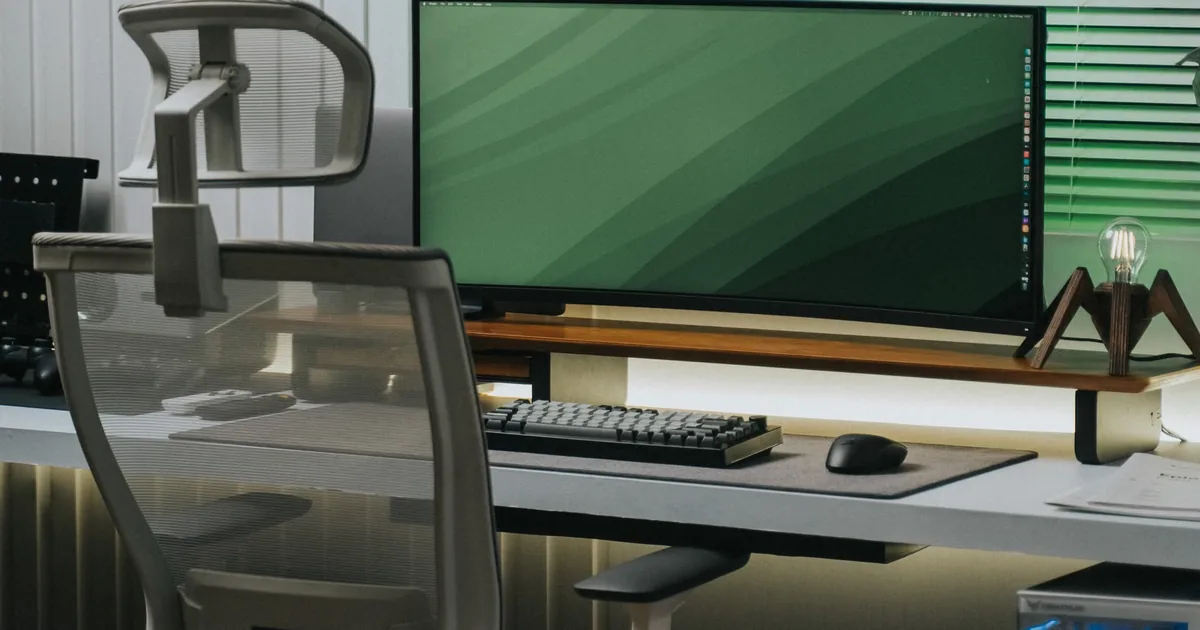
- Screen top at eye level, an arm’s length away. Your head should not tilt down or up to read. If you use a laptop, raise it on a stand or books and use a separate keyboard.
- Feet flat on the floor, knees near 90 degrees. If your chair is too high for that, a footrest beats perching on the edge.
- Forearms supported, elbows near 90 degrees. Your wrists should be straight at the keyboard, not bent up like a pianist.
- Lower back against the chair with a natural curve. Use the chair’s lumbar support if it has one, and stop slouching forward toward the screen.
- Ears over shoulders, shoulders over hips. That is the “neutral” check, and it is a feeling to return to, not a pose to hold forever.
The desk movement protocol I give patients
This is the part that matters most, and it takes less than ten minutes of your workday:
- Every 30–45 minutes: stand up for 1–2 minutes. Refill water, stretch, walk to the printer. A timer app helps until it becomes automatic.
- Every hour: one 60–90 second mobility snack. Doorway chest stretch, shoulder rolls, a standing hip hinge, or ten slow squats. Targeted stretching and light strengthening scored best in the exercise-snack trials.
- Once a day: a 10–15 minute walk, ideally outside at lunch. If you want to know why walking earns its keep, our walking benefits guide covers the evidence.
- Two to three evenings a week: 20–30 minutes of strength work for glutes, core, and upper back. This is the prescription that changes the next ten years of your spine, not the next hour.
The honest read on chiropractic care for desk pain
I am a chiropractor, so let me be straight with you, including about my own profession. The updated Cochrane review on spinal manipulative therapy for chronic low back pain finds it has a modest effect compared with other active treatments, and it works for some people, not everyone. That is the evidence, and any practitioner who promises more than that is selling you certainty the science does not have. Manual care, including spinal manipulation and mobilization, can be a reasonable part of a plan that also includes exercise, movement breaks, and good sleep. It is not a replacement for them, and a practitioner who treats you forever without teaching you how to take over is doing you a disservice.
When to see a doctor, not a chiropractor
Some back pain is not desk pain, and it needs medical evaluation first. See a physician promptly if you have any of these red flags:
- Pain radiating down the leg below the knee, especially with numbness or tingling.
- Weakness in a leg or foot, or loss of bladder or bowel control. This is urgent, go to an emergency department.
- Fever, unexplained weight loss, or pain that came with trauma or a fall.
- Pain that does not improve after a few weeks of the basics above.
For everything else, the answer is boring and effective: move more, sit less long, and get strong. That combination has more evidence behind it than any product marketed to desk workers.
Your desk posture starter
- Adjust your screen, chair, and keyboard in the five-minute neutral setup above.
- Set a timer for every 45 minutes, and stand for two.
- Do one mobility snack an hour: stretch the chest, roll the shoulders, hinge the hips.
- Walk 10 minutes at lunch, outside if possible.
- Strength train twice a week, and let that be the backbone of your back.
Reviewed by Dr. Rachel Stone, MD. This article is for education, not medical advice. Always talk to a qualified provider before changing your health routine, and get medical evaluation for any red flags above.
Your move: set the timer right now. Not the monitor, not the chair, the timer. Every 45 minutes, stand up for two. That single habit is the highest-evidence intervention in this entire article.



Leave a comment