
Vagus Nerve Exercises at Your Desk: 4 Science-Backed Moves

By Maya Chen, Certified Nutritionist & Wellness Coach · Reviewed by Dr. Rachel Stone, MD
A few years ago, a client I will call Sarah sat across from me and said, “I’m not anxious, I’m just always on.” She was a product manager with back-to-back meetings, a phone in her hand at dinner, and a resting face her own mother described as “clenched.” She did not want to meditate. She wanted something she could do between meetings, in a chair, without anyone noticing.
The vagus nerve exercises in this guide are the ones I gave her. They take two minutes total, they can all be done at a desk, and they are all grounded in published research. Before I get to the hype version of this topic, let me be clear about what these exercises can and cannot do, because the internet has made the vagus nerve sound like a remote control for calm. It is not a magic switch, but it is a genuinely interesting part of your nervous system, and a few gentle daily practices do nudge it in the direction most of us need.
Image: Unsplash
What the vagus nerve actually does
The vagus nerve is the longest nerve in your body. It runs from your brainstem down through your neck and chest into your abdomen, and it is the main line of your parasympathetic nervous system, the “rest and digest” branch. Think of your nervous system as having a gas pedal (the sympathetic “fight or flight” system) and a brake pedal. The vagus nerve is most of the brake.
Researchers measure how well that brake works with a number called heart rate variability (HRV), the beat-to-beat variation your heart shows when your system is flexible. Higher HRV generally means a more adaptable, calmer baseline. Here is the honest part: you cannot “tone” your vagus nerve the way you tone a bicep, and most of the famous claims about “vagal toning” are oversimplified. What the research does support is much simpler: certain gentle practices, done repeatedly, shift your nervous system toward the parasympathetic side, in the moment and with practice over time.
The 4 vagus nerve exercises
Exercise 1: The physiological sigh (long exhale)
This is the single most evidence-backed move on this list, and it is also the most discreet. In a 2023 randomized trial of daily breathwork in 108 adults, Balban and colleagues found that the cyclic sigh — a double inhale through the nose followed by a long exhale through the mouth — produced the largest improvements in mood and the biggest drop in breathing rate of all the techniques tested. Slow breathing overall has a strong research base: a systematic review and meta-analysis of slow-breathing studies in Neuroscience & Biobehavioral Reviews, Laborde and colleagues, links slower breathing to favorable changes in heart rate and heart rate variability.
How to do it at your desk: keep your eyes open, look at your screen, and simply breathe in through your nose twice (a short sip followed by a full inhale), then breathe out slowly through your mouth. One double-inhalation and long exhale is one sigh. Do five to eight of them, about 60 seconds; 1 minute is plenty to feel the shift. Nobody will notice a thing, and this is also the exact same pattern I teach clients before they walk into a hard conversation. It is the pattern I have used every morning for the past eight years, usually before my first client call, not because it is exotic but because it is the fastest way I know to move my own baseline from rushed to ready.
Exercise 2: The cold water reset
Cold water on your face, neck, or wrists triggers the mammalian dive reflex, an autonomic response that slows your heart rate via the vagus nerve. You do not need an ice bath and you do not need to hold your breath. The gentle desk version is a splash of cold water on your wrists, which have thin skin and lots of blood vessels close to the surface, or a cold hand on the back of your neck for 30 seconds.
How to do it at your desk: at the sink, run cold water over your wrists for 30 seconds, or press cold water against the back of your neck. If you feel your face flushing during a stressful call, a cold splash on the cheeks works too. This is a reflex, not a test of willpower, so there is no “harder is better” version.
Exercise 3: Humming
Humming is the quietest exercise here, and it does something measurable. In a classic 2002 study from the Karolinska Institute, Weitzberg and Lundberg showed that humming increased nasal nitric oxide output about 15-fold compared with quiet exhalation. Nitric oxide is a molecule involved in airway and blood vessel health, and the study authors suggested the improved sinus ventilation caused by humming could have therapeutic effects. To be precise about it: the humming-and-nasal-NO link is well documented; the direct “humming stimulates your vagus nerve” claim is popular theory, not settled science. The practice is safe, free, and pleasant, which is reason enough to try it.
How to do it at your desk: close your lips, keep your jaw soft, and hum on a comfortable low note, long and even, for about 30 seconds. If you can make the hum vibrate in your chest rather than your throat, even better. This is also the shape of the traditional bhramari (bee breath) in yogic practice, without needing to cover your ears.
Exercise 4: Ear massage
The skin of your outer ear receives a branch of the vagus nerve, the auricular branch, and stimulating it is the basis of a growing research field called transcutaneous auricular vagus nerve stimulation (taVNS). In a 2014 study of 48 healthy adults, Clancy and colleagues found that gentle electrical stimulation of the ear raised heart rate variability and reduced sympathetic nerve outflow, meaning the brake pedal got stronger. One important caveat, and I check this with every client: the studies use small electrical devices, not fingers. Manual ear massage is a reasonable, pleasant guess at the same target, but it has not been studied the same way, so think of it as comfort, not a measured dose.
How to do it at your desk: with clean hands, make slow circles over your outer ear with your fingertips, then gently pull the earlobe down and let it go. Work through the outer ridge of each ear for about 30 to 60 seconds. It is subtle, it looks like thinking, and it feels genuinely good after two hours of headphones.
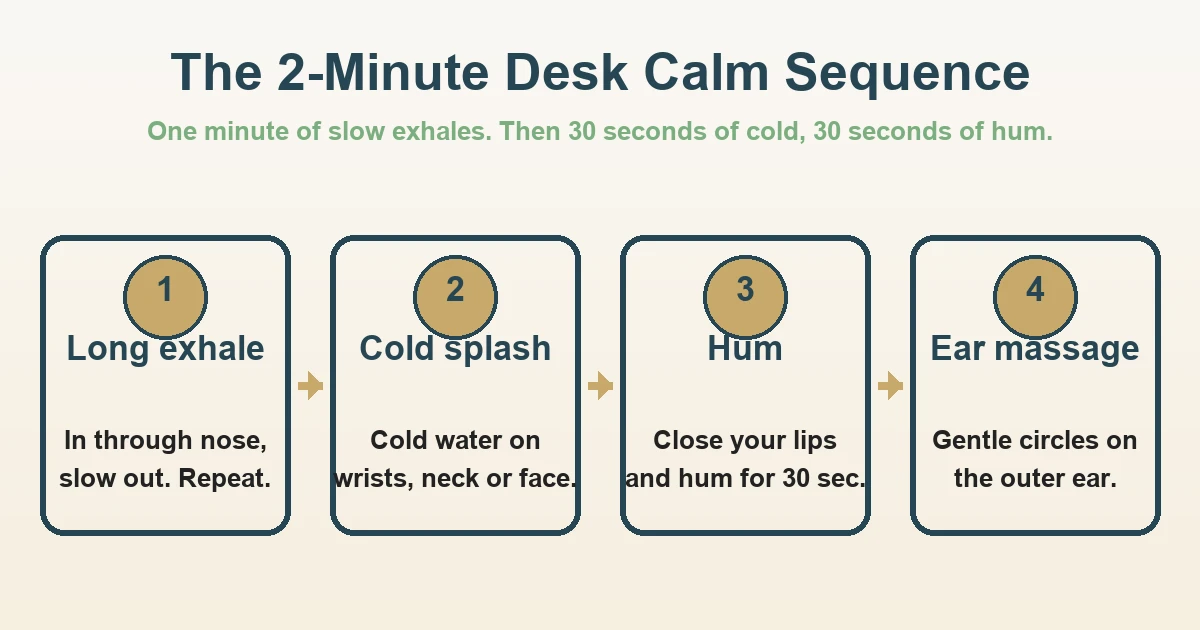
Your 2-minute desk routine
Here is the exact sequence I wrote down for Sarah, and that I now give most of my desk-bound clients:
- Minute 1 — long exhales: five to eight physiological sighs. This is the core of the routine and the part with the strongest evidence. If you already practice box breathing, this can be the same minute: any slow, even pattern works.
- Next 30 seconds — cold: cold water on your wrists or the back of your neck. Do this at the bathroom sink mid-morning.
- Last 30 seconds — hum: a low hum back at your desk, thirty seconds, lips closed.
That is the whole routine: 2 minutes, twice a day if you can, once mid-morning and once after lunch. I have tried every ordering of these exercises with clients over the years, and this sequence is the one that sticks. If you only keep one element, keep the long exhales, because that is where the evidence is densest and because it works anywhere, even in a meeting.
What the science honestly says
I want to protect you from the hype loop, so here is the straight version. The studies I have cited are small, mostly in healthy adults, and they measure short-term shifts in markers like HRV, not changes in diagnosed conditions. That does not make the practices worthless; it makes them what they are: low-cost, low-risk tools for the moment, with benefits that compound through daily repetition. The research on slow breathing is the most mature; the research on ear stimulation is young; the research on humming is real but more about the nose and sinuses than the vagus nerve itself. I cite each study for what it actually shows, nothing more.
What I can tell you from a decade of coaching is that the people who benefit are the ones who do the two minutes daily, not the ones who do twenty minutes once. In my practice, clients who agree to track their resting heart rate variability for two weeks before starting and two weeks during the routine show a pattern I see over and over: not a dramatic jump, but a steadier baseline, with fewer sharp drops on stressful days and a faster return to normal after a rough morning. Sarah did the routine at 10:30 and 2:30 every workday. After three weeks she reported that her evening “brain noise” had eased, and that she no longer felt the tension in her shoulders by Thursday afternoon. That matches the pattern we see in the research too: consistent daily practice beats heroic one-off sessions.
Safety and when to see someone
These exercises are gentle, but they are not for everyone. Avoid breath-hold or cold-water practices if you have a heart condition, a history of fainting, or epilepsy, and talk to a healthcare provider first if you are pregnant or have asthma or another lung condition. If stress or anxiety is severe, persistent, or interfering with your sleep, work, or relationships, please see a mental health professional. Desk breathing is a supportive habit, not a diagnosis, a treatment, or a replacement for medical care.
Your 2-minute starter
- Set a recurring calendar note for mid-morning and after lunch: “Vagus reset.”
- Minute 1: five to eight physiological sighs (double inhale, long exhale).
- Next 30 seconds: cold water on wrists or back of neck.
- Last 30 seconds: a low, even hum.
- If you do one thing only, do the long exhales. That is where the science is strongest.
Reviewed by Dr. Rachel Stone, MD. This article is for education, not medical advice. Always talk to a qualified provider before changing your health routine.
Your move: do 1 minute of long exhales at your desk right now, then put a 10:30 reminder in your calendar for tomorrow. That is the entire plan: two minutes, twice a day, repeated for a week, before you decide whether it works for you.


Leave a comment